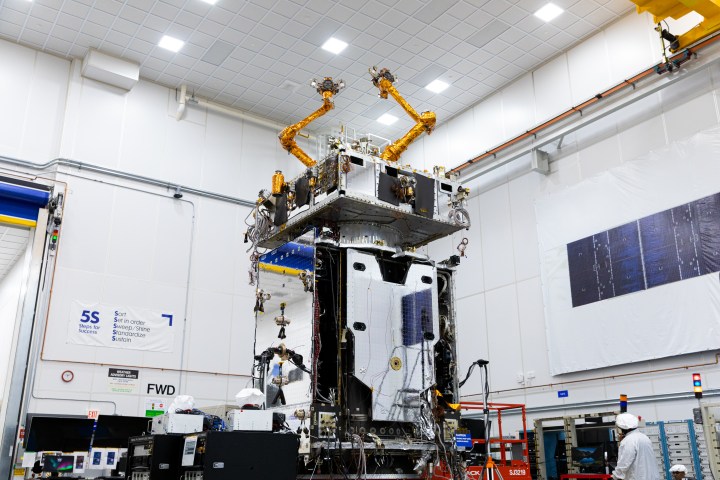
The concept of a mechanic in space—a robot that can fix or refuel a satellite—is finally transitioning from a theoretical exercise to a viable commercial service, and the core technology just got a major upgrade. This week, Northrop Grumman’s older-generation Mission Extension Vehicle (MEV) successfully detached from an Australian communications satellite, a task that was always part of its service plan. But the maneuver isn’t just a routine operational step; it’s a handoff. It clears the docking port for a far more advanced successor: the Mission Robotic Vehicle (MRV), which launched in July and is now en route to its destination.
The MRV represents a significant advancement in in-orbit servicing. While its predecessors—MEV-1 and MEV-2—were essentially space tugboats that could only dock with and push a satellite to keep it in its correct orbital slot, the new spacecraft comes equipped with two advanced robotic arms. Its first job is not just to nudge a satellite, but to install a small propulsion pod onto the Optus satellite, a process that requires a delicate, autonomous grapple and attachment procedure. This capability fundamentally shifts the business model for satellite life extension.
An Old Design Makes Way for the New
The story began in 2009 when the Optus satellite was launched into geostationary orbit, approximately 27,000 miles above the Earth. This orbit is prime real estate for communications and broadcasting, where a satellite appears to remain in a fixed position relative to the ground. For over a year, the MEV spacecraft was physically docked to the back of that satellite, effectively acting as its propulsion system to keep it in the correct position. It was a successful proof-of-concept.
However, that era of “simple” docking is now being superseded. The recent Falcon 9 launch carried a new fleet of four spacecraft to orbit: the main MRV and three smaller Mission Extension Pods (MEPs). These MEPs are essentially modular thruster units. Instead of the MRV itself acting as a permanent tug, it will act as a robotic installer. According to the company’s timeline, in 2027, the MRV will use its robotic arms to attach one of the MEPs to the Optus satellite. Once attached, the pod becomes a permanent part of the Optus spacecraft, providing it with a new lease on life.
A New Business Model for Satellites
The most important change here is the economics of the service. The old model required satellite operators to contract a large, expensive servicer (the MEV) to remain attached to their satellite for years. This meant the servicer was committed to a single client for a long duration. The new model allows operators to buy and own the MEP—a smaller, simpler, and theoretically cheaper asset—that becomes a permanent part of their satellite. The MRV acts as a “tow truck” that can install these pods on multiple satellites over its lifespan.
Northrop Grumman’s Cassie Wong has described this as a “paradigm shift” towards a more sustainable and resilient architecture. This isn’t just about saving a few old satellites; it’s about creating a logistics infrastructure in space. By making these services more accessible and cost-effective, it encourages operators to view their spacecraft as assets that can be upgraded and maintained rather than discarded when their fuel runs out. For a company like Optus, which launched its satellite in 2009 with a 15-year lifespan, the ability to add a few more years of operation can translate to millions of dollars in continued revenue.
Background and Context: From Tugboats to Robots
To appreciate the MRV, you have to look at its predecessor, the MEV. The first MEV launched in 2019, and there are currently two in orbit. These vehicles have provided about 10 years of life extension to three different customers, including Intelsat. The MEVs work by using a docking probe that physically inserts into and hangs onto the satellite’s thruster nozzle. It’s a proven but clumsy solution.
The MRV, however, was developed in part by DARPA, the U.S. military research organization. This partnership highlights the dual-use nature of the technology. While Northrop emphasizes that its vehicles are solely for servicing, the robotic arm technology has inherent strategic value for the Department of Defense, which is deeply interested in the ability to inspect, repair, or potentially refuel its own costly assets in high orbits. This is a classic case of military research paving the way for commercial innovation.
The Robotic Arm and the Pods
The technical challenges involved in this transition are substantial. The spacecraft involved are moving at thousands of miles per hour, and the docking process must be fully autonomous. The MEV used a physical probe, but the MRV must use a robotic arm to carefully align and attach an MEP. The margin for error is essentially zero. A single mistake could damage a million-dollar satellite.
Furthermore, the MRV itself is designed to be refueled in orbit. This is a crucial feature. If the in-orbit servicing model becomes the norm, future satellites will need to be designed with “refueling ports” or grapple fixtures. Currently, the weight and cost of adding such hardware is a deterrent for operators who are used to building their satellites to be disposable. The MRV serves as a proof-of-concept that fuel depots and robot mechanics are a viable future for the industry.
The Economics of “Good Enough”
There is a compelling tension in the satellite industry. On one side, you have the “LEO constellation” model, championed by companies like Starlink, that relies on launching hundreds of cheap, easily replaceable satellites. In that model, the cost of repair is irrelevant; you just launch a replacement. On the other side, you have the “GEO giant” model, where a single large communications satellite can cost hundreds of millions of dollars.
The real question that Northrop Grumman’s MRV is answering is whether the middle market is worth saving. There are many satellites launched in the last 10-15 years that were expensive enough to be worth repairing but not so expensive that the military or a major government entity will foot the bill. The MRV provides a mechanism to extend their lives at a lower cost.
However, the high cost of the MRV itself and the complexity of the mission reveal a persistent issue in the space industry. We are still incredibly far from a “Jiffy Lube in orbit” scenario. Every time a robotic arm moves to attach a pod, it carries the risk of catastrophe. While the service is a clear value-add for a specific class of aging assets, it doesn’t necessarily signal a “transformation” of how all satellites are built. It is more accurate to view the MRV as a specialized, high-value tool for a niche but lucrative segment of the market, largely driven by defense contracts and a few legacy communications operators. The real game-changer will be when servicing technology becomes cheap and simple enough that it can be applied to the disposable LEO satellites, but we are likely a decade away from that scenario, if it ever arrives.
Industry Implications: A Sign of Maturity
The arrival of the MRV is a strong indicator that the space industry is maturing. In any other industry, maintenance and logistics are standard. The fact that companies are now building dedicated servicing vehicles suggests that the space ecosystem is transitioning from a “launch and leave it” model to a more circular one. This trend is echoed by other players, such as the startup Katalyst Space, which is attempting to fix a NASA space telescope after a malfunction.
Interestingly, this capability also introduces new risks. The U.S. Space Force has previously characterized Chinese spacecraft with robotic arms as potential weapons, highlighting the dual-use nature of the technology. This will likely lead to calls for greater transparency in the operations of such vehicles to avoid misunderstandings or escalations in the increasingly crowded space environment.
Northrop Grumman’s MRV is not just a replacement for the older MEV; it is a strategic upgrade designed to lower the barrier to entry for satellite life extension. By using a robotic arm to attach smaller, customer-owned pods, the company has created a more scalable and flexible business model. While the technology is impressive, its ultimate significance lies in the economic logic it represents: that for a certain class of high-value assets, it is now cheaper to call a mechanic than to buy a new machine.
The 2027 mission to attach a pod to the Optus satellite will be a defining test. If it succeeds, it will validate the MRV’s design and open the door for servicing more satellites in both high and low Earth orbits. However, the broader implication is that the space industry is slowly, and cautiously, building the infrastructure to treat its assets as reusable and maintainable, a development that will only become more critical as orbital real estate becomes more contested and valuable.